

Σε αυτή τη σελίδα
Σε αυτή τη σελίδα
A Historical Overview
The history of the Holy Monastery of Koudoumas is closely linked to Saints Parthenios and Eumenios, who restored the monastery. During the 19th century, these two ascetics, seeking a place of absolute tranquillity and prayer, arrived in the remote area of Koudoumas, where there were traces of an earlier place of worship.
According to tradition, the Saints miraculously discovered the icon of the Dormition of the Theotokos, an event considered to be the starting point for the monastery’s re-establishment. Through hard work, faith and an ascetic way of life, they rebuilt the monastic complex, which gradually developed into an organised men’s monastery.
The official foundation of the modern monastery is dated to the late 19th century, whilst its reputation spread rapidly throughout Crete due to the holiness of its founders.
Saints Parthenios and Eumenios
Saints Parthenios and Eumenios are central figures in the spiritual tradition of Koudoumas Monastery. They lived a life of strict asceticism, fasting and unceasing prayer, facing extreme hardships due to their isolation and the harshness of their environment.
Their lives and work left a deep mark on the popular piety of Crete. Following their passing, they are venerated as saints of the Orthodox Church, whilst their relics are reverently enshrined in the monastery.
Architecture and Monastic Complex
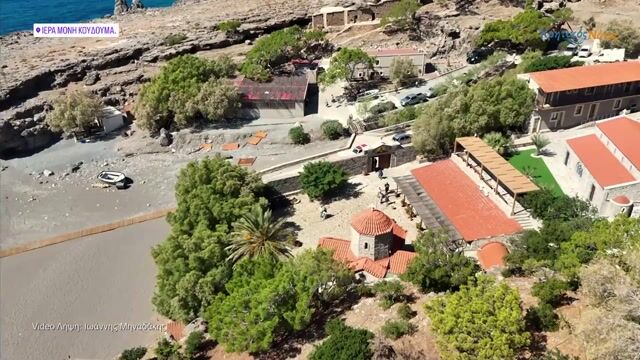
The monastic complex of the Holy Monastery of Koudoumas is simple and in harmony with its natural surroundings. The main church is dedicated to the Dormition of the Mother of God and is notable for its simplicity and devotional atmosphere.
The monks’ cells, ancillary buildings and courtyards are built of stone, in keeping with traditional Cretan monastic architecture. The site also features caves where monks once practised asceticism, reinforcing the site’s character as a centre of asceticism.
Spiritual Life and Worship
Koudoumas Monastery operates as a communal monastery for men and follows the strict rules of Orthodox monastic life. The monks’ daily routine includes liturgical services, work, study and welcoming pilgrims.
Of particular significance is the celebration of the Dormition of the Theotokos (15 August), when the monastery is flooded with thousands of worshippers from all over Crete. The pilgrimage is accompanied by all-night vigils, processions and a deeply spiritual atmosphere.
The Koudoumas Monastery Today
Today, the Holy Monastery of Koudoumas continues to be a living spiritual beacon for Crete and the whole of Greece. Despite the difficulty of access, many pilgrims visit the Monastery in search of silence, prayer and inner peace.
The Holy Monastery of Koudoumas is not merely a historic monastery, but a place of profound spirituality, where human faith meets the rugged beauty of the Cretan landscape. The story of Saints Parthenios and Eumenios, the seclusion, prayer and the grandeur of nature combine to form a unique whole that makes Koudoumas Monastery one of the most sacred and awe-inspiring places in Crete.Video
Tik-tok :https://www.tiktok.com/@johnminad
Instagram : https://www.instagram.com/giannis_mndks
Video Gallery